THE WEST AFRICAN EXAMINATIONS COUNCIL GHANA
Basic Education Certificate Examination
Integrated Science 2003
OBJECTIVE TEST
Objective Test
Question 1
Question 2
Question 3
Question 4
Question 5
Question 6
Question 7
Question 8
Question 9
Question 10
Question 11
Question 12
Question 13
Question 14
Question 15
Question 16
Question 17
Question 18
Question 19
Question 20
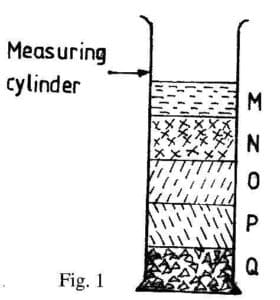
Question 21
Question 22
Question 23
Question 24
Question 25
Question 26
Question 27
Question 28
Question 29
Question 30
Question 31
Question 32
Question 33
Question 34
Question 35
Question 36
Question 37
Question 38
Question 39
Question 40
THEORY
ESSAY
Answer three questions only from this section. Illustrate your answers wherever possible, with large, clear and fully labelled diagrams. Credit will be given for clarity of expression and orderly presentation of material. All questions carry equal marks
Question 1
(a) (i) Define photosynthesis (ii) Give two ways in which photosynthesis is important to animals [5 marks] (b) Name three sources of chemical energy [3 marks] (c) Describe how you would separate a mixture of sodium chloride and sand [4 marks] (d) Complete and balance the following chemical reaction: CaCO3 + HCl → [4 marks] (e) Two dry cells, a switch and a bulb are connected in series. Draw and label a circuit diagram of the arrangement [4marks]
Question 2
(a) State two precautions that should be taken to prevent the spread of each of the following diseases: (i) cholera (ii) smallpox [4 marks] (b) Describe how you would test for starch in a leaf. [6 marks] (c) Draw and label the structure of an atom containing three electrons. Indicate the charges of the particles. [6 marks] (d) (i) Explain why an inclined plane is classified as a machine (ii) Give two reasons why the output energy of a machine is always less than the input energy. [4 marks]
Question 3
(a) Name the two processes that lead to the formation of seeds in a flowering plant [2 marks] (b) (i) Give five components of blood (ii) State three functions of blood [8 marks] (c) (i) What is an electrical insulator? (ii) Mention three examples of insulators (iii) Give two characteristics of an insulator that explain its behaviour [7mks] (d) Classify the following substances under the three states of matter: petrol, palm oil, soap, carbon dioxide, corn flour, smoke [3 marks]
Question 4
(a) (i) What is a deficiency disease? (ii) Give two deficiency diseases and their causes. [6 marks] (b) (i) State the importance of excretion in living organisms. (ii) Name two excretory organs of the human body and the substances they excrete. [6 marks] (c) (i) Explain why gases are more compressible than solids. (ii) Give two areas where the compressible nature of a gas is applied [4 marks] (d) A piece of stone is dropped from a height to the ground. State the energies possessed by the stone (i) just before it was released from the maximum point; (ii) midway between the fall; (iii) just before it hit the ground. [4 marks]
PART I [40 marks]
Answer all of Question 1
Questions for this section are in the printed paper.