THE WEST AFRICAN EXAMINATIONS COUNCIL GHANA
Basic Education Certificate Examination
Integrated Science 2022
OBJECTIVE TEST
Objective Test
Question 1
The energy transformation that takes place in a solar cell is
Question 2
All flowering plants end their life cycle with
Question 3
Soil texture is a term used to describe the
Question 4
Which of the following processes is an example of a physical change?
Question 5
An example of a storage pest is
Question 6
The solid component found on the filter paper and the liquid component that flows into a container during filtration are respectively called
Question 7
A capacitor is connected in a series circuit with LED, a battery and a switch. When the circuit is closed, the LED
Question 8
The ion that causes hardness in water is
Question 9
Which of the following substances are matter?
I. Hydrogen
II. Air
III. Stone
Question 10
The main reason for staking tomato is to ensure
Question 11
Which of the following statements about clayey soil is not true? It
Question 12
It is not advisable to use old electrical gadgets because they
Question 13
Which of the following planets are closer to the sun than the Earth?
Question 14
Which of the following statements about pressure in liquids is/are correct?
I. Pressure in liquids at the same level acts equally in all directions.
II. Pressure in liquids depend on the area of the liquid.
III. Pressure in liquids decreases with depth.
Question 15
Soil depletion is not caused by
Question 16
What force makes a ripe mango fall from a tree?
Question 17
Urea is a good source of
Question 18
Which of the following statements are reasons for conserving energy?
I. Insufficient production of energy
II. Increasing demand of energy
III. Limiting production of carbon (IV) oxide
Question 19
A force meter measures
Question 20
Which of the following bodies are natural sources of light?
I. Moon
II. Sun
III. Glow Worm
Question 21
Which of the following characteristics is/are of the image formed in a pinhole camera? The image is
I. inverted.
II. virtual.
III. diminished.
Question 22
The floor of a room has length 20 m and breadth 15 m. Determine the area of the floor.
Question 23
Rainfall is a result of
Question 24
An example of a first class lever is
Question 25
Green plants have the ability to make their own food hence they are known as
Question 26
The periodic table is an arrangement of elements according to increasing
Question 27
The number required to make the following chemical equation balanced is:
H2 + O2 → H2O
Question 28
The ovary, style and stigma are collectively known as the
Question 29
A mixture of alcohol and water can best be separated by
Question 30
An atom 2311X forms bond by losing one electron, the charge on the ion formed is
Question 31
The hard outer surface of a tooth is called
Question 32
People who travel in space are called
Question 33
The practice of growing cowpea and maize on a piece of land at the same time is known as
Question 34
A lunar eclipse may occur when the
Question 35
Which of the following instruments can be used to measure the diameter of a circle?
Question 36
When gases are heated they
Question 37
The shoot system of a flowering plant develops from the
Question 38
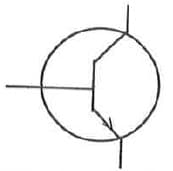
The diagram below is an illustration of a transistor.
The arrow shows the direction of:
Question 39
Digestion of protein begins in the stomach and ends in the
Question 40
Which of the following substances is a compound?
THEORY
ESSAY
This paper is in two parts: I and II. Answer Question 1 in part I and any other four question in part II
Question 1

- The diagrams below are illustrations of an experimental set-up. Study the diagram carefully and answer the questions that follow. Identify each of the parts labelled I, II and III. Name the method of separation in each of the set-up: Α: A; Β: B. State the class of mixtures that the experimental set-up A could be used for. Give a reason for the answer stated in (iii). Name one possible component of the mixture in set-up B. State the function of the part labelled IV.
- The diagram below is an illustration of a part of a system in human Study the diagram carefully and answer the questions that follow. Name the system illustrated. Name each of the parts labelled I, II, III, and IV. What is the role of the part labelled I? Name three diseases that affect the system illustrated.
- The diagram below illustrations of devices used to do work easily. Study the diagram carefully and answer the questions that follow. Identify the apparatus illustrated. Name each of the parts labelled I, II, and III. Give one use each of the parts labelled I and II. What ecological factor was measured? State three ways in which the ecological factor measured in (iv) is important in agricultural soils. Name one farm tool that aids the ecological factor measured in (iv) to perform its function in agricultural soils. Describe how the farm soil tool named in (vi) is used to aid the factor measured in the experiment.
- The diagrams below are illustrations of electrical circuits. Study the diagram carefully and answer the questions that follow. Identify each of the components labelled I, II, and III. State the type of arrangement of resistors (R) in B. State the effect of the arrangement of resistors in each of the diagrams A and B on III. Give a reason for each of the answers stated in (iii).
PART I [40 marks]
Answer all of Question 1
Questions for this section are in the printed paper.
PART II [60 marks]
Answer all of Question 1
Question 1
- State three differences between metals and non-metals in terms of their physical properties.
- Explain the term active region as applied to transistors; State what happens in the active region of a transistor.
- State two effects of lack of protein in the diet of humans. Describe briefly the chemical test for glucose.
- What are soil resources? State two agricultural activities which make the soil lose its nutrients.
Question 2
- List in the correct order, the organs through which food passes from the mouth to the anus.
- State the components of a balanced ration for feeding poultry.
- Predict the products formed when: magnesium solution reacts with dilute hydrochloric acid; potassium reacts with water.
- State two effects of heat on a substance. Potassium permanganate crystals are dropped into a beaker of water and warmed: α) State what would be observed; β) State the phenomenon demonstrated in (α).
Question 3
- Name the stages in the life cycle of a mosquito. Name the stage at which feeding does not take place.
- Explain briefly why air is regarded as a mixture.
- What is a magnetic pole? State two uses of temporary magnets.
- Give four reasons for planting crops in rows.
Question 4
- Name two elements which make the teeth of mammals strong. Name two common diseases of the human teeth.
- State three reasons why sandy soil cannot support effective plant growth.
- Draw and label the structure of the atom. State its valency.
- State three ways in which fluid pressure is applied in everyday activities. State one substance that is an insulator.
Question 5
- Explain the term mixed cropping.
- What is an alloy? Name the constituent elements in brass.
- State three effects of dumping waste materials into water bodies. State one function of each of the following factors in photosynthesis: α) chlorophyll; β) water.
- What is work? A block of wood of mass 10 kg was dragged through a distance of 3.2 m when a force of 20 N was applied. Calculate the work done.