THE WEST AFRICAN EXAMINATIONS COUNCIL GHANA
Basic Education Certificate Examination
Mathematics 2020
OBJECTIVE TEST
Objective Test
Question 1
Simplify:
3
4
-
1
3
+
1
12
Question 2
Given that N = {x:x is a factor of 18} and M = {x:x is a multiple of 12}, find N ∩ M.
Question 3
Express 4382.93 in standard form.
Question 4
Which property of arithmetic is used in a(x+y) = ax + ay?
Question 5
Subtract (7x-3) from (5-3x).
Question 6
The cost of 12 note books is GH₵ 54.84. Find the cost of one note book.
Question 7
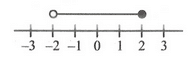
Which of the following inequalities is represented on the number line?
Question 8
Simplify: (2ab²)² x 3a³b.
Question 9
Which of the following polygons does not have a line of symmetry?
Question 10
A trader sold a radio set for GH₵ 72.00 making a profit of 8%. Find, correct to the nearest Ghana cedi, the cost of the radio set.
Question 11
Vera is 11 years old and her brother is 9 years old. They shared 60 oranges in the ratio of their ages. How many more oranges does Vera get?
Question 12
If (x-3)² = 16, find the positive value of x.
Question 13
Find the image of the point (-2,3) under a reflection in the y-axis.
Question 14
What fraction of 3 weeks is 18 days?
Question 15
What is the median of the following numbers: 4, 16, 13, 18, 3, 20, 6, 7, 15, 2, 10, 12?
Question 16
If , find the value of w.
Question 17
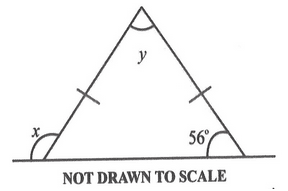
Use the diagram below to answer the question 17 and 18
Find the value of x.
Question 18
Find the value of y.
Question 19
A car used 8 hours to travel from town A to town B at a speed of 18 km/h. Find the distance travelled.
Question 20
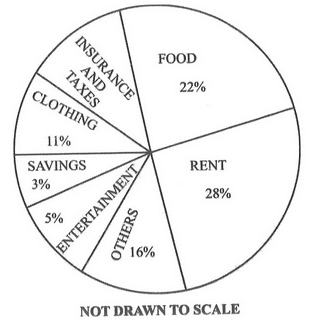
The pie chart shows the household budget of a family. Find the angle for INSURANCE AND TAXES.
Question 21
The pie chart shows the household budget of a family. If the family's income was GH₵ 40,000.00, how much was spent on clothing?
Question 22
Two sides of a parallelogram are 5.8 m and 8.2 m long. Find its perimeter.
Question 23
A man earned an interest of GH₵ 240.00 in 4 years at 20% per annum simple interest. Calculate the principal.
Question 24
A labourer worked for 20½ hours. If he was paid GH₵ 2.50 per hour, what was his total wage?
Question 25
If 480 pupils in a school are boys representing 80% of the school's enrolment. Find the total number of pupils in the school.
Question 26
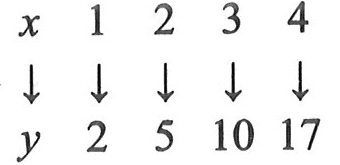
What is the rule for the mapping?
Question 27
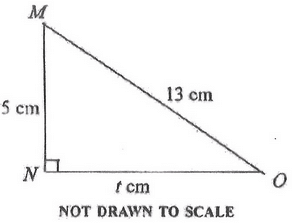
Find the value of t in the diagram.
Question 28
Add the following numbers: 2.4, 0.042, 1.12, and 0.342.
Question 29
Solve: 4x = 32.
Question 30
Find the equation of the straight line passing through the points (-3, 5) and (6, 8).
Question 31
There are 15 females in a debating club. If the ratio of females to males is 3:2, how many members are in the club?
Question 32
If P1(4, -5) is the image of P(x, y) translated by r = (-2, 3), find the values of x and y.
Question 33
If 2y = 1 - 3x² + 4x, find y when x = -1.
Question 34
Given that p = {1,2,3,4,5,6,7,8,9,10,11,12}, what is the probability of selecting a prime number from the set?
Question 35
Solve: 3 - (3x+4) ≤ -4.
Question 36
Two sides of a rectangle are 10 cm and 6 cm. Calculate the area of a square with the same perimeter as that of the rectangle.
Question 37
Make n the subject of the relation.
y
=
n
-
x
x
Question 38
Expand and simplify: (a-2)(2a+3).
Question 39
Simplify 2² x 2⁷ ÷ 2⁴.
Question 40
If P = {7,11,13} and Q = {9,11,13}, find P ∪ Q.
THEORY
ESSAY
This paper is in two parts: I and II. Answer Question 1 in part I and any other four question in part II
Question 1

- The diagram below are illustrations of two cells labelled A and B Study the diagram carefully and answer the questions that follow. Name each of the parts labelled I, II, III and IV. Which of the parts named in (a)(i) is the same as the parts labelled VI and IX in cell B? Which of the cells is a plant cell? Give two reasons for the answer given in (a)(iii). Tabulate two differences between the parts labelled I and V.
- The diagram below is an illustration of an experiment carried out in the laboratory. Study the diagram carefully and answer the questions that follow. Read and record the: α) mass of irregular object (M) in I β) Volume of water (V1) in II γ) Volume of water (V2) in III Determine the volume of the irregular object. Calculate the density of the irregular object. Name the instrument that could be used to measure the mass of an irregular object. State one precaution to be taken in performing the experiment.
- The following activities were performed in the laboratory by groups of pupils. Study the activities and answer the questions that follow. Camphor was heated. Wood was burnt. Iron nails were heated strongly. Sodium chloride was dissolved in water. Which of the following activities are: (α) chemical processes; (β) physical processes. Give two reasons why the activities listed in: (α) are chemical processes; (β) are physical processes. Give two examples of physical change that take place in your environment.
- A farmer cultivated soya bean, yam and maize on a farm in a rotational programme as illustrated below. Study the diagram carefully and answer the questions that follow. Copy and complete the table. List three principles to consider when planning this rotational programme. Give two reasons for selecting the crop named for V in plot 1 year 3. State one advantage of practising this farming system.
PART I [40 marks]
Answer all of Question 1
Questions for this section are in the printed paper.